

A coffee table that does not scratch: why stainless steel outlasts lacquer and wood
A table that stays presentable under daily use is not a matter of luck; it is a function of material science and finish. Wood and lacquered tops carry a surface film or a soft substrate that records scuffs, rings, and dents. Stainless steel, specified and finished correctly, resists that cycle of visible wear and can be renewed without replacement.
What actually scratches: films versus metals
Most wooden coffee tables rely on a protective coating. Lacquer is a thin, hard film applied over the timber. It performs well when intact, yet grit, keys, or the bottom rim of a mug abrade the coating, not the wood itself at first. Over time, those micro‑cuts expose the substrate, which then accepts moisture and pigments. Rings, ghost stains, and local delamination appear and repairs require sanding and re‑coating across a larger area to blend. As Flooring Surgeons notes in its care guidance for lacquered floors, regular maintenance helps but does not prevent cumulative abrasion; once a film is breached, you repair the finish, not simply clean it.
Oiled or raw wood responds differently. There is no hard film; the fibres compress and the grain takes the mark. This has character, but dents and water marks are literally within the material. Spot fixes are possible, yet repeated touch‑ups change sheen and colour across the top.
Stainless steel works on another principle. It is a homogenous, hard substrate protected by a self‑healing passive layer rich in chromium oxides. When the surface is scratched lightly, the mark sits within the finish, not in a vulnerable coating; the chromium‑rich layer reforms in air and protects the bulk metal. The British Stainless Steel Association describes this passivation mechanism in detail, explaining why the protective film is continuous and resilient in normal interior conditions.
Stainless steel, passivation, and the role of finish
Two factors govern how a steel coffee table handles daily life: alloy and finish.
- Common interior grades are AISI 304 and 316. Both are austenitic stainless steels with good corrosion resistance for homes. 316 adds molybdenum, improving tolerance to chlorides. For coastal interiors or poolside rooms, 316 is prudent. For most living rooms, 304 is entirely appropriate.
- The finish controls how visible and repairable light marks appear. Grain direction and reflectivity matter more than sheer hardness.
Consider these finishes as they relate to a coffee table:
- Brushed or satin: Linear grain diffuses fingerprints and disguises micro‑scuffs from books or remotes. Light abrasions can often be blended along the grain with a fine Scotch‑Brite pad.
- Bead‑blasted: A uniform, matte texture hides fingerprints, though local burnishing from repeated contact can create subtle sheen shifts over years.
- Mirror: Highly reflective, visually crisp, and more revealing of fingerprints and fine lines. It is best for low‑touch zones or when a dramatic effect is desired.
- Electropolished: The surface is smoothed at a microscopic level, reducing crevices where contaminants cling. It shows contact but cleans easily and retains brightness.
Because stainless steel relies on its chromium‑rich passive layer rather than a lacquer film, surfaces can be refinished. Rebrushing or repolishing is a measured intervention, not a full strip and recoat. The British Stainless Steel Association provides a technical overview of passivation and why a cleaned surface naturally reforms its protective layer in air: passivation of stainless steels
In interiors, a brushed or satin finish earns its place in active rooms. As ArchDaily observes in its survey of stainless steel in interior design, the material’s clarity sits well with warm woods, stone, and soft textiles, and a satin surface offers visual calm that tolerates daily contact.
Uppsala by Acier Studio: designed for daily use
Uppsala is our stainless steel coffee table conceived for homes that live actively. The top presents a restrained, brushed field paired with partially polished details that catch light without exaggerating fingerprints. Day to day, the surface accepts glasses, keys, and stacked magazines with little visible change. When a micro‑mark appears, you read it in the grain rather than as a white scratch through a coating, and it can be blended along the brush direction.
A continuous lower shelf doubles the working surface, keeping the top clear while absorbing the traffic of books and remotes. Edges are softened to the touch and transitions are fully blended, so nothing snags or chips. Welds are dressed until the geometry reads as one plane. The table sits low and substantial, which steadies it under weight and lends visual calm in a living room.
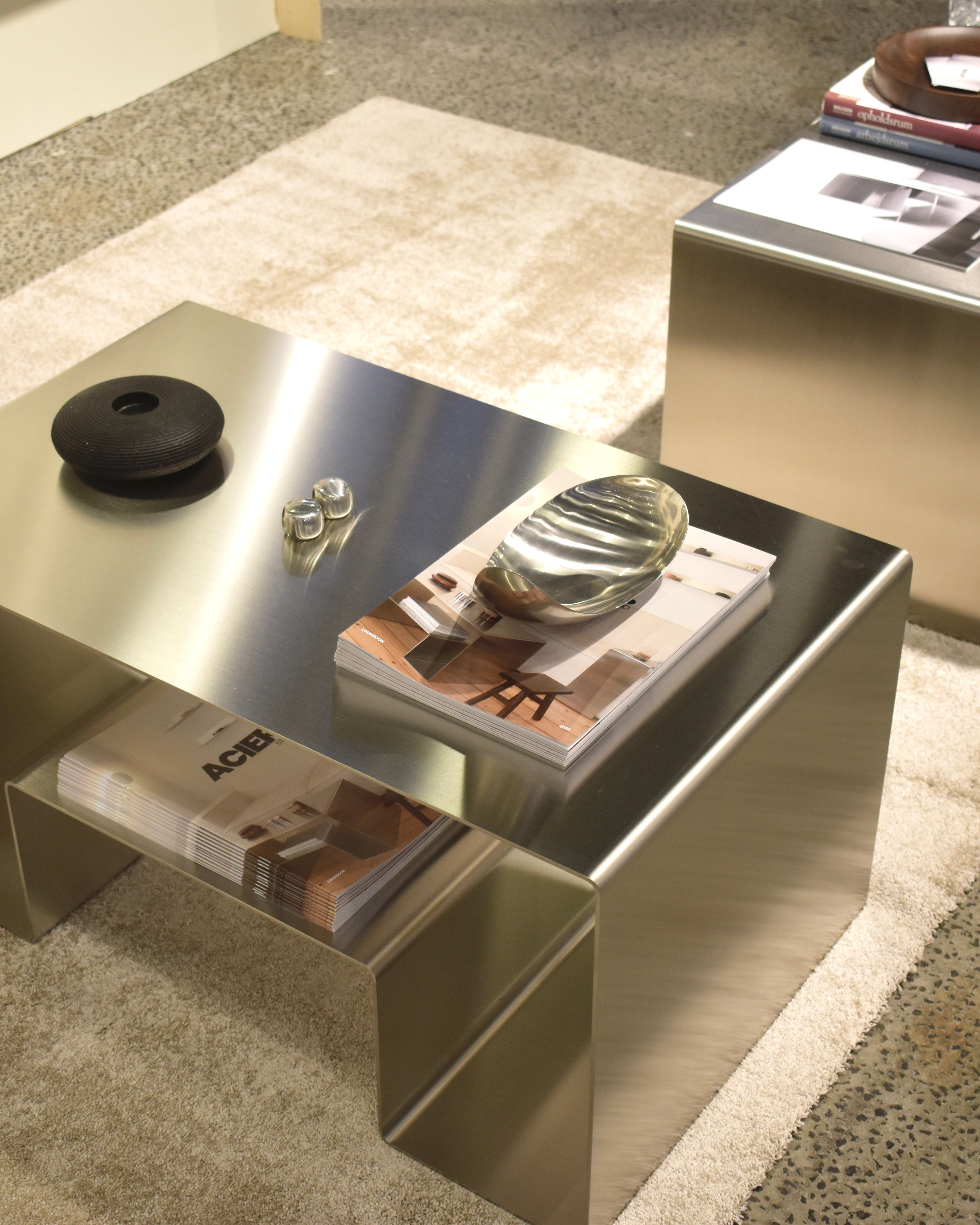
See the proportions and dual‑surface layout here: Uppsala coffee table
Craft matters: Danish fabrication that reduces visible wear
A scratch‑resistant table is not only about alloy; it depends on how the metal is cut, joined, and finished. In Aarhus, our team manages tight tolerances at every step: precise mitres, full‑penetration welds, and careful edge preparation so that the brushed grain runs cleanly across junctions. After fabrication, we carry out finish‑specific passivation and final brushing to standardise the grain direction. These steps are slower than mass production but they reduce the pathways for visible wear; you are less likely to see mismatched grain, torn edges, or heat tint at welds that would attract dirt.
This approach sits within a Danish craft tradition that values designer oversight and local fabrication. As Danish Made by Hand explains in its profiles of workshops, the discipline of small‑scale metalwork—measured fit‑up, consistent finishing protocols—directly influences longevity and the way a piece ages in use.
Maintenance that is honest and effective
Stainless steel is not immune to contact, yet it handles evidence of life without permanent damage when maintained sensibly.
- Daily: Wipe with a soft microfibre cloth dampened with warm water. Dry with a second cloth to prevent water shadows.
- Weekly: Use a neutral pH stainless cleaner or diluted dish soap. Work with the grain, not across it.
- Fingerprints: For brushed or satin finishes, a light mist of isopropyl alcohol on a cloth removes oils cleanly.
- Scuffs: For a visible line in the grain, use a fine non‑woven pad, always in the grain direction, with light pressure; stop early and check progress.
- Avoid: Chloride‑heavy cleaners and bleach. They can attack the passive layer, especially on 304 grade near kitchens. Also avoid abrasive powders that cut across the grain.
- Practical habits: Felt pads under ceramics prevent trapped grit from dragging. Coasters are optional for stainless, but they make sense for glassware that sheds mineral rings.
If a surface ever needs full renewal, a professional rebrush or electropolish returns uniformity without removing significant material. Unlike lacquer, there is no film to strip and reapply.
Long‑term value
A coffee table earns its keep by how it looks after five or ten years. Wood and lacquer reward care but record inevitable events—grit under a book, a wet glass on a warm evening—and those marks often trigger large‑area refinishing. Stainless steel, selected in the right grade and finished with intention, accepts the same use, resists staining through its passive layer, and can be restored locally when needed. In practice, that means your table continues to read as intended while accommodating a life with glasses, keys, and books, which is the point of a coffee table in the first place.

