

Steel Coffee Table Anchors the Living Room
A steel coffee table unifies the seating area, manages distances and light, and balances the room's visual weight. Its correct placement in relation to the sofa, rug, and lighting determines whether the table feels light and fluid in the space or a calm, anchoring weight that holds the decor in place.
Placement and Proportions
A steel foundation makes the tabletop precise and level; leverage this to ensure ergonomics. Maintain 40–45 cm from the sofa edge to the front edge of the table to allow for both good legroom and easy reach for cups and books. The table height should be flush with the seat height or 1–2 cm lower, providing a natural hand position when relaxing.
The rug is the anchor for the entire group. Either the front sofa legs rest on the rug, or you let the rug extend 30–40 cm past the sides of the sofa. This particularly binds steel with softer materials like wool and leather and prevents the table from visually "floating" on the floor.
Light should be directional. A floor or table lamp with a diffused shade placed diagonally in front of the table reduces glare from steel and sculpts the surface. Choose warm-white light sources and, if desired, use a narrow spot on decorative objects on the table instead of direct light onto the surface.
Material and Surfaces in Stainless Steel
For furniture, austenitic grades such as 304 and 316 are typically used. Both have high formability, good tensile strength, and a density of approximately 7.9 g/cm³, resulting in sleek but rigid constructions. 316 contains molybdenum; as Hardware Custom describes, it significantly improves resistance to chloride and pitting corrosion, relevant in coastal humidity or frequent spills.
The surface determines reflection, cleaning, and perceived weight. As the British Stainless Steel Association (BSSA) points out, bead and shot blasting create an even, diffusely reflective texture that dampens glare and conceals small marks (see bssa.org.uk/bssa_articles/specifying-bead-and-shot-blasted-stainless-steel-finishes-and-their-applications/). Other common finishes:
- No.4 brushed: linear abrasion, lower glare, hides fine scratches, easy to maintain with brushing direction
- Satin: softer reflection than brushed, uniform and calm on large surfaces
- Mirror: high reflection, visually expands the room, but requires careful wiping
- PVD tones: colored layers on steel, alter appearance and reduce fingerprints, but should be handled gently
The finish affects the perception of volume: the more matte and sandy, the "heavier" the body appears; the more finely brushed or mirrored, the lighter and more light-bearing.
Copenhagen: Lightness and Precision in the Living Room
Acier Studios Copenhagen is designed as a light anchor; a slender plate of approximately 4 mm stainless steel on an open, minimal base that allows the rug and floor to show through. The brushed or matte surface accepts daylight without glare, and the thin edge provides a precise cut in the room. In a calm living room with a linen sofa, Copenhagen appears as a quiet, reflective surface that supports a few dark ceramic objects and a tray without dominating. As a pair, it works convincingly with the sculptural Oslo pedestal, which can stand to the left of the sofa with a wooden object for tactile warmth. The overall composition shows how steel can be integrated into a soft, grounded palette.
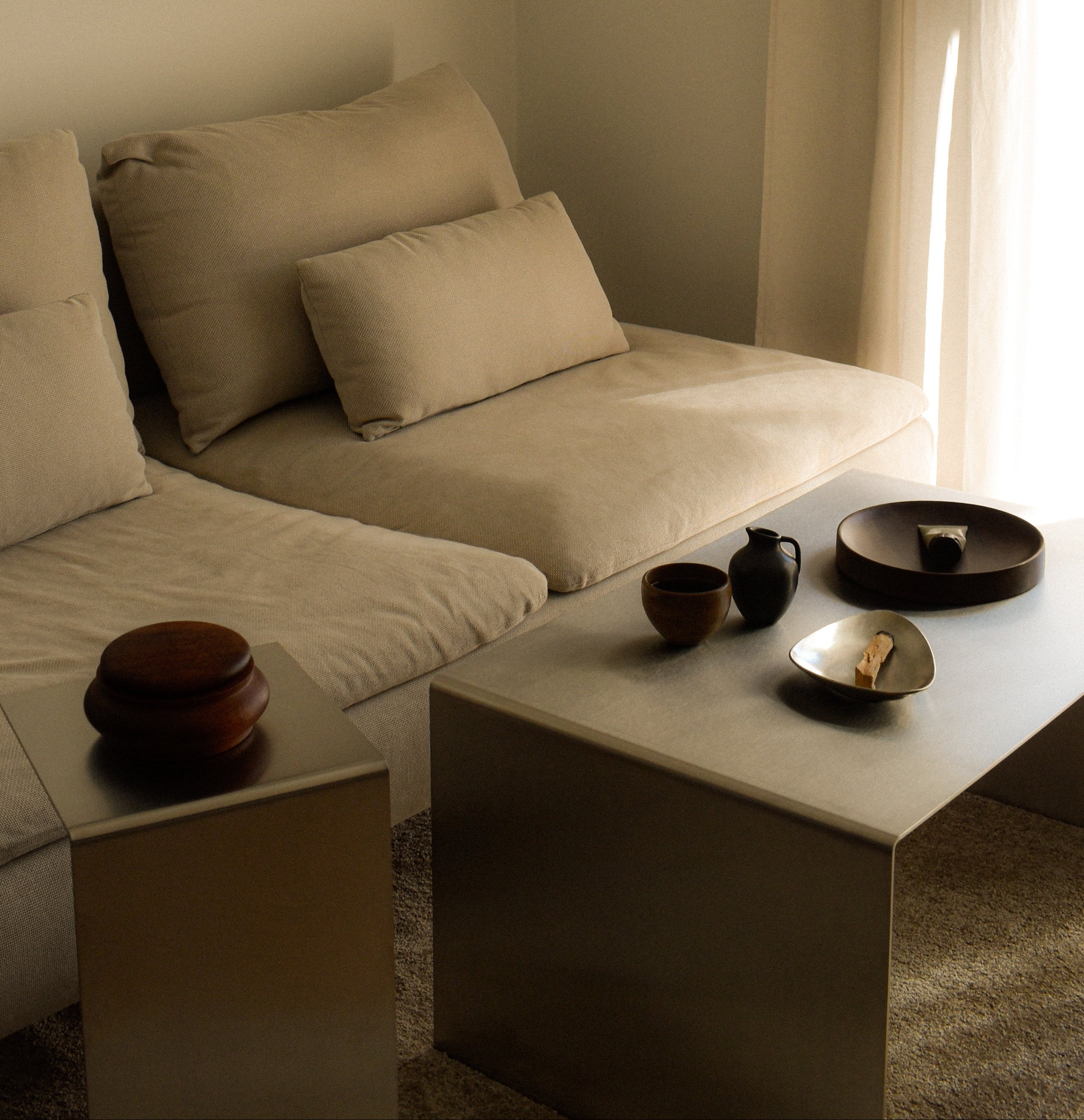
Place Copenhagen 40–45 cm from the sofa, and let the top edge of the table be flush with the height of the cushions. On a rug where the front sofa legs are firmly placed, the open base becomes part of the whole. A shielded reading lamp placed diagonally behind the corner of the sofa directs light towards objects on the table and creates depth without harsh glare. See more specifications for the Copenhagen coffee table.
Uppsala and the More Grounded Interpretation
Where Copenhagen reads as light and almost floating, Uppsala is conceived as a calmer weight. Its cubic geometry, thicker plates, and a consistently matte surface create a solid, architectural body. It is perceived as a base that "holds" large sofas or spacious living rooms, especially on rugs with more volume.
To integrate the greater visual weight, the rug should be generously sized, either with the front legs on it or with the rug's edge extending 30–40 cm beyond the sofa's sides. Layering with wool, leather, and wood reduces the temperature difference between steel and textiles. Use directional light from a low height to define edges, not overhead light, which can flatten the form.
Danish Craftsmanship, Maintenance, and Long-Term Value
Acier Studios furniture is produced in small series in Aarhus. Each weld is blended to a cohesive line, edges are hand-satinized, and tolerances are kept tight so surfaces meet precisely. This approach differs from mass production with spot welding, solely CNC finish, and powder coating, where one often sees coarser joints and thicker surface layers. Designmuseum Danmark's narrative of Danish design is precisely material-driven and craft-based; objects are developed for long-term use, not just for unboxing. Research into regional design ecosystems points in the same direction, where small workshops extend longevity through repair and refined finishing.
Maintenance should be realistic:
- For daily use, a microfiber cloth lightly dampened with pH-neutral soap, wiping in the direction of the grain on brushed surfaces.
- Avoid chlorine- and bleach-containing agents; if salts or acids are spilled, wipe and rinse with clean water, especially on 304. 316 tolerates more, but also thrives best without standing moisture.
- Use felt under bowls and ceramics. Mirror finish requires a soft cloth and clean, dust-free surfaces to avoid swirls. Bead or sandblasted surfaces show fewer fingerprints but should not be rubbed hard with abrasive sponges.
In the long run, brushed surfaces can be refreshed with a fine abrasive pad in the direction of the grain, while larger marks can be re-coated in PVD or re-polished in a workshop. Stainless steel constructions maintain their shape without swelling or warping, even with changing temperatures and humidity.
Long-term value arises when proportions, materials, and execution work together. A stainless steel coffee table with well-considered geometry, correct finish, and craftsmanship retains its precision, patinates with subtle hairline traces of use, and can be maintained instead of replaced. In a living room that changes over decades, it becomes a stable reference point that still unifies the seating group, rug, and light.

