

Floating Shelf vs. Visible Brackets: When Does the Floating Effect Make the Most Sense — and What Does It Require from the Wall?
A floating shelf works best when the wall can bear the load without visible aids, and when the overall impression of the room benefits from an unbroken, horizontal line. Visible brackets can be rational in workshop or kitchen zones where frequent rearrangement and direct access to the bracket are advantageous. If you choose the floating solution, both the load path, wall construction, and material stiffness must be in place; otherwise, the shelf will sag, or the illusion will be broken by shadows and tolerances.
Purpose and Load: When the Floating Line Makes the Most Sense
The floating shelf solves two tasks simultaneously: it supports and it visually disappears. It is ideal for living rooms and hallways with a calm, Scandinavian aesthetic, where lines and materials are allowed to stand alone. Choose a slender profile and an underside without joints if the primary purpose is light objects such as books, small bowls, or art books. For daily use with higher weight—for example, stacks of plates—the shelf can be designed as a closed box profile for better bending stiffness; this, however, requires a deeper, hidden rail over which the shelf can be pushed.
In rooms with visual and practical robustness, such as utility rooms or workshops, visible brackets are often more flexible. They accept point loads, are easy to replace, and can be dimensioned more robustly without being an eyesore.
Stainless Steel for Floating Shelves: Alloy, Surface, and Stiffness
Stainless steel scales the strength of the floating shelf without becoming bulky, but the choice of alloy and finish matters. According to Hubs' overview of stainless steel, austenitic grades 304 and 316 are the most commonly used for indoor furniture because they combine formability, weldability, and high corrosion resistance. 316 with molybdenum is recommended near coasts and in wet areas where chlorides can otherwise cause pitting corrosion. Outokumpu describes in their corrosion guides that proximity to chlorides and moisture accelerate pitting; here, 316 provides an extra safety margin (Outokumpu – https://www.outokumpu.com/en/expertise/2021/corrosion-guides).
The surface controls both expression and patination:
- No.4 brushed hides fine marks in the grain direction and appears visually light.
- 2B appears calm and technical, but shows pressure marks more clearly.
- Mirror polished reflects light the most, but reveals scratches fastest.
How thin a floating shelf can be without sagging depends on the material's yield and tensile strength, the shelf's geometry, and the quality of the hidden welds and rail. Good weld restraint and uniform heat input avoid stresses that can otherwise pull the shelf out of plane and create visible shadows against the wall.
Wall Conditions and Mounting: The Hidden Solution Requires a Clear Load Path
A floating shelf is only as good as its anchor. The load must go into something solid, and the rail must have enough depth to be completely hidden by the shelf's profile.
- Drywall on steel or wood studs: find studs, or use heavy-duty toggle anchors. Avoid drywall-only anchoring for heavy tasks.
- Brick or concrete: use expansion anchors or chemical anchors with appropriate drilling depth.
- Aerated concrete: requires special anchors and often longer drilling to prevent pull-out.
The rail should match the shelf thickness so that the underside remains flat and the front line does not have a visible shadow gap. The depth of the rail and the number of tabs must reflect the load and span; large spans without central support require a deeper and stiffer profile.
First Impression: Skagen Floating Shelf in Brushed Steel
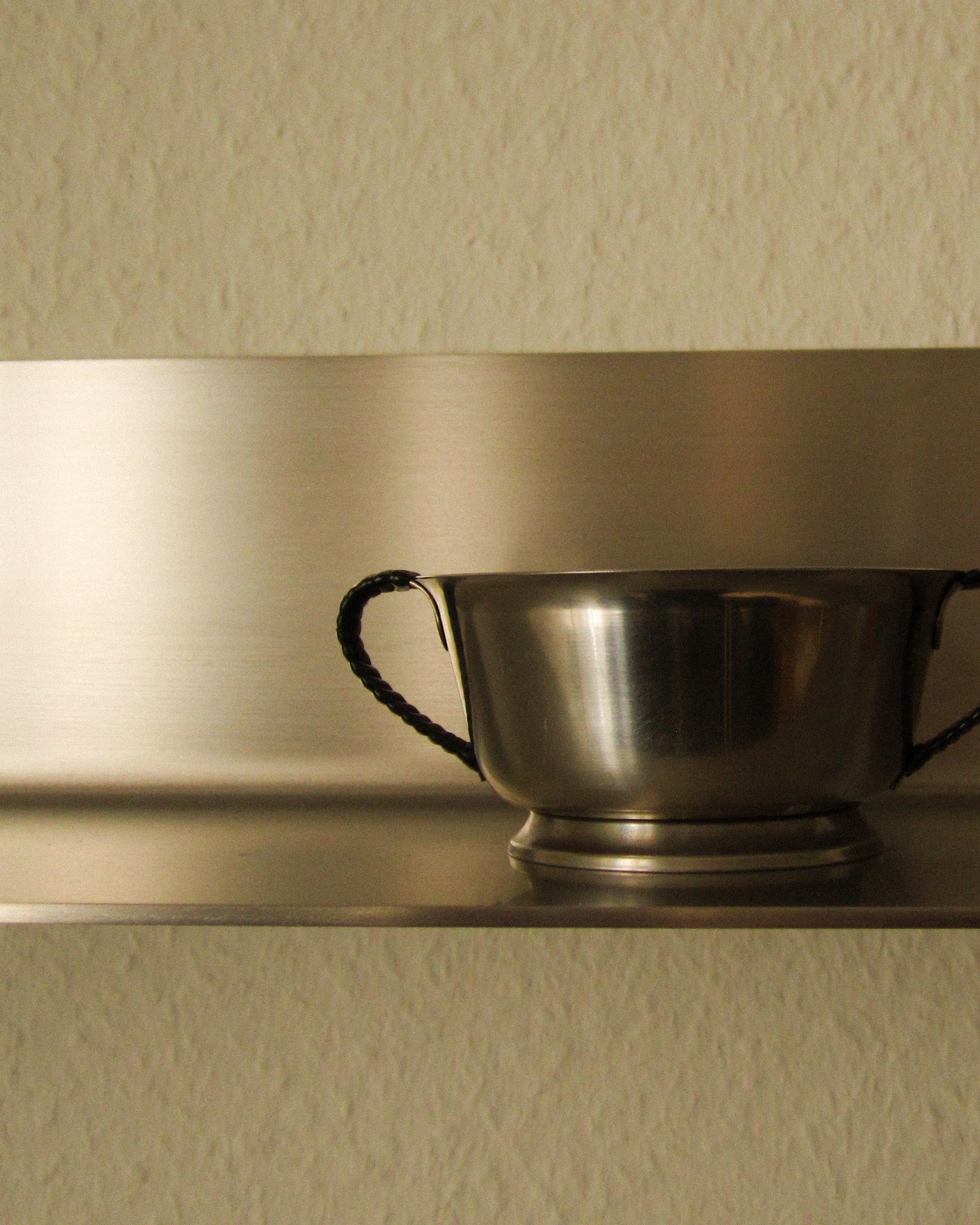
Acier Studio's Skagen is designed as a clean, floating line in stainless steel, where the underside reads as a single plane. In practice, this means a hand-ground, brushed backplate, precise edge radii, and hidden fastenings that do not break the wall surface. In the close-up below, a vintage-inspired steel bowl with braided handles rests on the shelf; the light catches both the brushed backplate and the polished surface of the bowl, creating a tonal interplay between the two steel types. The absence of visible brackets shows that the rail is fully integrated, and the shelf's depth and load-bearing capacity are reflected in the calm shadow against the wall.
Skagen is produced in small series in Aarhus with hand-welded, post-processed joints where weld zones are dressed in the grain direction to blend into the overall surface. Passivation after grinding helps reduce visible heat zones and maintains the illusion of an unbroken surface. Learn more about the product here: Skagen steel shelf.
Danish Craftsmanship: Tolerances, Surfaces, and Visual Tranquility
Small series allow for sharpened tolerances, uniform brush structure across the entire shelf plane, and edge radii adapted to the shelf's depth, so light reflects calmly along the front. While mass production often solves the task with spot welds and standard profiles, we work with fully welded corners, controlled heat input, and post-processing that allows the shelf to be read as one piece. This precision is crucial on the wall, where even millimeter deviations create shadows that disrupt the floating effect.
Maintenance: Honest About Brushed and Polished Steel in Use
Brushed stainless steel tolerates daily touch and subtly shows small marks if simple routines are followed:
- Wipe in the grain direction with microfiber and lukewarm water; spot cleaning can be finished with a mild, pH-neutral soap.
- Avoid chlorine-containing agents and steel wool; they can provoke discoloration and scratches.
- For light "tea staining" in bathroom areas, rinsing with clean water and wiping dry helps; in coastal homes, occasional passivating cleaning with citric acid-based agents is sensible.
- Small scratches on a brushed surface can be toned down with a fine Scotch-Brite pad in the grain direction. Mirror-polished surfaces require more care; use a silicone-free polishing paste and expect micro-marks to always be more visible on mirrors.
If the shelf is exposed to salty air or frequent water vapor, 316 alloy is a wise choice; Outokumpu documents its higher resistance to chloride-induced pitting corrosion.
Long-Term Value
A good floating shelf is not just an image of minimalism; it is a technical solution where material, wall, and craftsmanship work together. When the alloy, surface, and anchoring are chosen based on the room and application, the shelf maintains its line and surface for many years. The visual calm gained is a direct result of precise tolerances and maintainable materials—a discreet investment in everyday quality.

