

Coffee Table Built to Last: Stainless Steel Outside the Replacement Cycle
Most coffee tables are replaced long before they are physically worn out. The reason is rarely a single defect, but a combination of material fatigue, surface wear, and changing trends. At Acier Studio, we deliberately work with materials and construction that don't force you into that cycle.
Why Most Coffee Tables Are Replaced Within a Decade
Replacement often occurs when:
- veneer frays, lacquer peels, or particle board swells along edges from spills and moisture; within a few years, the table appears stained and flimsy
In the fast-furniture segment, short lifespans are part of the model: cheap joints, thin surfaces, and shifting trends shorten the actual useful life. Research on "fast furniture" indicates that in many cases, the lifespan is only a few years, not because the table inevitably breaks, but because materials and finish cannot withstand everyday use or be properly repaired. This makes stainless steel an exception in the furniture category, as it is both structurally stable and locally repairable with sanding and polishing over a long period.
The Material That Resists Time: Grade and Finish in Stainless Steel
Stainless steel forms a chromium-rich, passive film that protects against corrosion. The British Stainless Steel Association (BSSA) describes how this film regenerates naturally in oxygen, and how correct grade selection (typically 304 indoors, 316 in coastal environments) and an appropriate finish provide continuous resistance to stains, pitting, and atmospheric wear (source: BSSA). In a living room context, this means that a table will not degrade during damp winter months and does not require lacquers that can crack.
The surface treatment is just as crucial as the alloy. Mechanical grinding and subsequent polishing control how much dirt adheres, how clearly aging is visible, and how easily marks can be removed. According to BSSA, a brushed or satin-ground surface can be restored locally with controlled sanding in the grain direction and subsequent passivation. The result is not a cosmetic "patch-up," but a genuine extension of the useful life without replacement.
Firsthand Experience: Uppsala Coffee Table in Stainless Steel
Uppsala is our low-profile coffee table with an integrated lower shelf. The tabletop reads as a calm, flat surface where the brushing guides light in an even direction, while subtly polished sections add depth without becoming mirror-like. The lower shelf supports the weight of magazines and books, leaving the top free for serving and objects; two usable levels in one robust steel body.
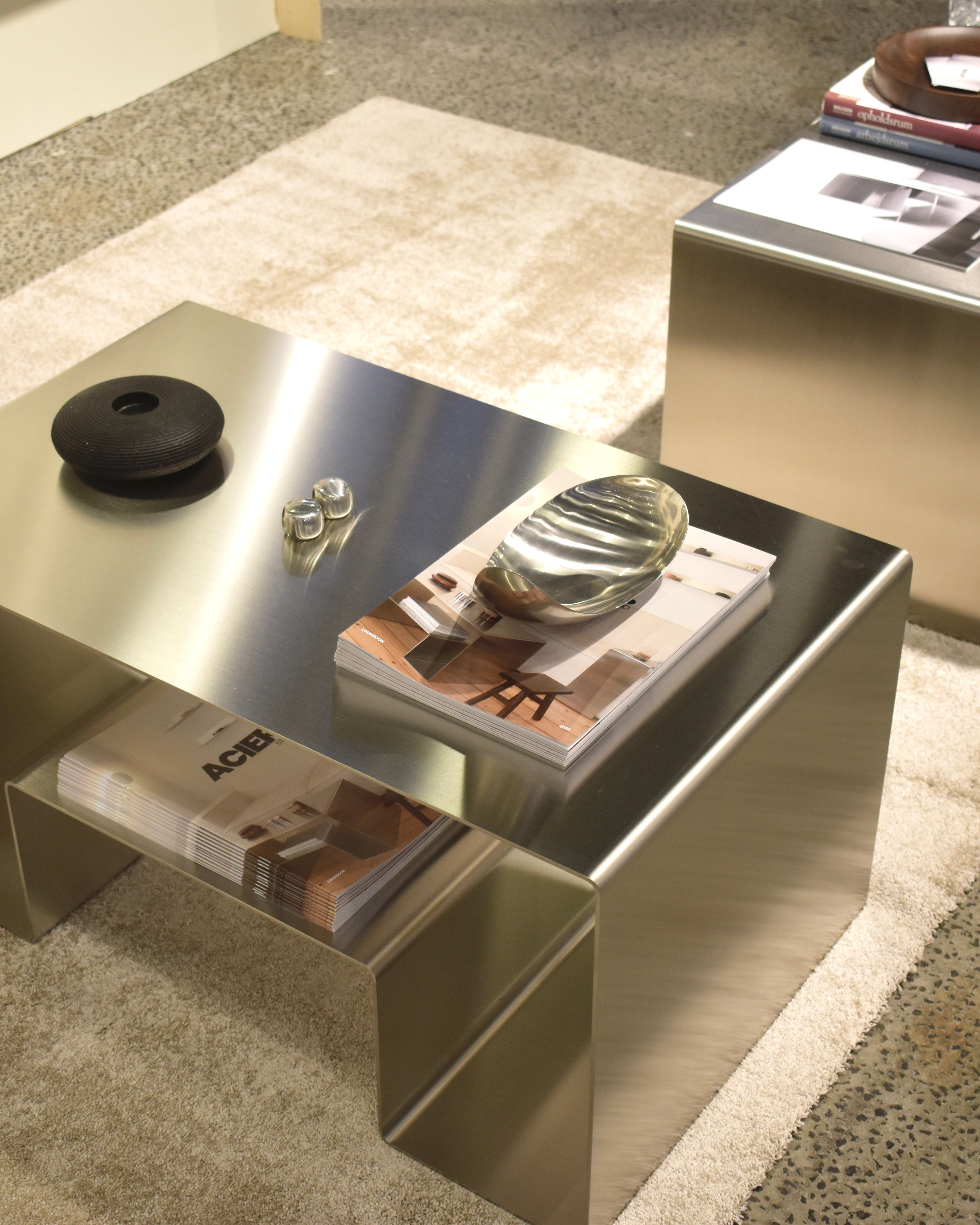
In a warm interior, Uppsala gathers surrounding materials rather than dominating. The steel surface plays cleanly against oak, walnut, leather, and stone. Its low height provides visual calm in compact living rooms, while its precise geometry fits naturally into open-plan layouts. Experience from our workshop in Aarhus shows that precisely this combination of thin profiles and weight distribution in the steel provides stability without appearing heavy in the room. See more details about the Uppsala coffee table on our website.
Maintenance and Repair That Extend Lifespan
Stainless steel does not require gentle treatment, but honest care makes a difference over decades:
- Clean daily with lukewarm water and a soft microfiber cloth; for grease, use a pH-neutral dish soap, rinse, and dry in the grain direction.
- Avoid chlorine bleaches and strong acid-based descalers on the surface; if it happens, rinse quickly and thoroughly.
- Fingerprints on polished areas can be removed with ammonia-free glass cleaner, wipe in the grain direction.
- Small scratches on brushed surfaces can often be toned down with fine Scotch-Brite in the grain direction; mask off surrounding areas, work evenly, and finish with passivation gel intended for stainless steel.
- In coastal homes or during winter with road salt in the air, a light wipe more often is a good idea to prevent salt buildup.
- Place felt under ceramics with rough bottoms to avoid friction marks; hot pots do not require trivets, but can leave marks from the bottom, which can, however, be polished away.
Unlike lacquered wood surfaces, a steel surface can be treated locally without the entire table needing to be re-lacquered. For larger damages, a metalworker can polish or weld and then restore the finish; the process is known from industry and applied in the furniture workshop in the same spirit.
Aarhusian Craftsmanship and Long-Term Perspective
In Denmark, furniture production carries a culture of narrow tolerances, hand sanding, and reparable solutions. In our workshop in Aarhus, we prioritize fully worked-through joints, precise welds, and post-processing, so edges and surfaces meet cleanly. This results in fewer weak points, less creaking, and no flaking, which typically shortens the lifespan in mass-produced, trend-driven furniture. The Danish Architecture Center describes the same set of values as part of Danish design tradition, where durability and thoughtfulness precede quick effects.
In interior design, stainless steel functions as a calm, architectural element that takes color and texture from its surroundings. Publications like Livingetc have noted that subdued minimalism and "quiet luxury" gravitate towards tactile, lasting materials. A steel coffee table doesn't follow trend curves in the same way as colored veneers or short-lived laminates, and it can be patinated and refreshed without losing integrity. This provides a practical counterweight to the replacement culture that ResearchGate studies on "fast furniture", among others, have mapped out.
The long-term equation is simple: a stainless steel coffee table costs more to produce than particle board with thin veneer, but maintains its shape, withstands daily use, can be refreshed after accidents, and has high recyclability at the end of its life. When the material doesn't give in, and the finish can be restored, the table is not replaced to hide wear, but only when the room's needs truly change. That's where a coffee table built to last for many years pays for itself. BSSA's documentation of corrosion resistance supports the technical basis; experience from our workshop confirms it in practice.

