

Indoor Steel Wall Shelf: Mechanics, Fastening, and Longevity
Rigidity, Strength, and Corrosion Resistance in Wall Mounting
A stainless steel wall shelf functions because the material is rigid, strong, and resistant to degradation. Austenitic grades like 304 and 316 have a Young's modulus of around 190–200 GPa, meaning that even relatively thin plates or support brackets resist deflection at normal shelf depths. Simultaneously, the yield and tensile strengths, depending on the grade and thickness, provide significant safe working loads when the geometry is correct. According to Outokumpu’s core-range datasheet, these steel types also have a self-repairing passive chromium oxide film that protects against corrosion; after welding or machining, resistance is typically restored with pickling and passivation, preventing surfaces and screw holes from unevenly rusting (source: Outokumpu, see datasheet).
Rigidity is crucial for wall anchoring. A steel bracket of correct thickness will not “pump” around the screws. Where wood can shrink, and thin-stamped steel can warp, a precisely folded stainless steel bracket carries the load into the wall without concentrating stress at a single point. Rounded or slightly countersunk holes and ground edges reduce stress concentrations, preventing the material from working loose.
Additional security is achieved by letting the shelf's underside or back edge act as a small box profile or by adding backplates that connect multiple screws. This increases the cross-sectional inertia, limits deflection, and distributes the pull on the wall.
(Source: Outokumpu — https://www.outokumpu.com/)
Load Distribution and Wall Types: How to Avoid Failure
Reliable wall shelves are as much about the wall as they are about the shelf. The load must be distributed to multiple fasteners and into load-bearing zones in the wall. Fine Homebuilding describes that floating shelves and slender brackets should be anchored to studs or solid structures and, where this is not possible, to heavy-duty hollow-wall anchors. The basic principles are simple: more fixing points, greater distance between them, and a geometry that works in shear rather than pulling out.
- Wood wall with studs: Screw directly into studs with A2/A4 wood screws; use at least two, often three fixing points per bracket to spread the load.
- Hollow wall/drywall without studs: Use heavy-duty toggle anchors dimensioned according to weight and shelf depth; distribute the load across multiple anchors.
- Brick/concrete: Use expansion bolts or chemical anchors; clean and vacuum drill holes for full adhesion.
Ensure precise, flat contact surfaces between the bracket and the wall. Avoid sharp cutouts around holes and deburr to reduce local stresses. Use uniform stainless steel fasteners to prevent galvanic corrosion at contact surfaces. For deep, heavily loaded shelves for books or kitchenware, the bracket should have sufficient depth so that the moment from the load is absorbed by the steel profile rather than solely by the wall screws.
Danish Manufacturing: Geometry, Thicknesses, and Surface Treatment in Practice
In the Danish metalworking tradition, quality is not about extra ornamentation, but about thickness selection, geometry, and finishing. At Acier Studio in Aarhus, we work with thicknesses adapted to span and application, precise bending and TIG welding where it strengthens the joint, and controlled passivation after machining. This minimizes weak zones at holes and edges, where cheap, thinly stamped brackets typically give way over time.
The Danish Design Center, in its Material Insights, has described how precisely the detailed work in small series enables mounting solutions that distribute load and conceal fasteners without compromising service access. This difference is felt in the wall: a well-designed backplate, clean holes with slight chamfering, and a bracket that functions as a rigid profiled beam mean fewer retightenings and less work for the wall over the years.
In interior design, stainless steel reads calmly and precisely, especially when combined with warm wood species, sanded stone, and matte plastered walls. Livingetc specifically points out that Scandinavian interiors balance cool metals with tactile materials, so the overall impression remains warm, even when the shelf is austere.
Product Insight: Lund Wall-Mounted Bedside Table in Stainless Steel
Lund is our wall-mounted bedside table in stainless steel, constructed as a clean, folded form that utilizes the two wall surfaces of the corner. The directional, brushed surface catches the light and makes the geometry legible, while two visible mounting screws soberly demonstrate how forces are transferred into the wall. The corner mounting provides torsional rigidity, and the folded edges increase the cross-section's inertia, preventing the slender surface from flexing during normal use.
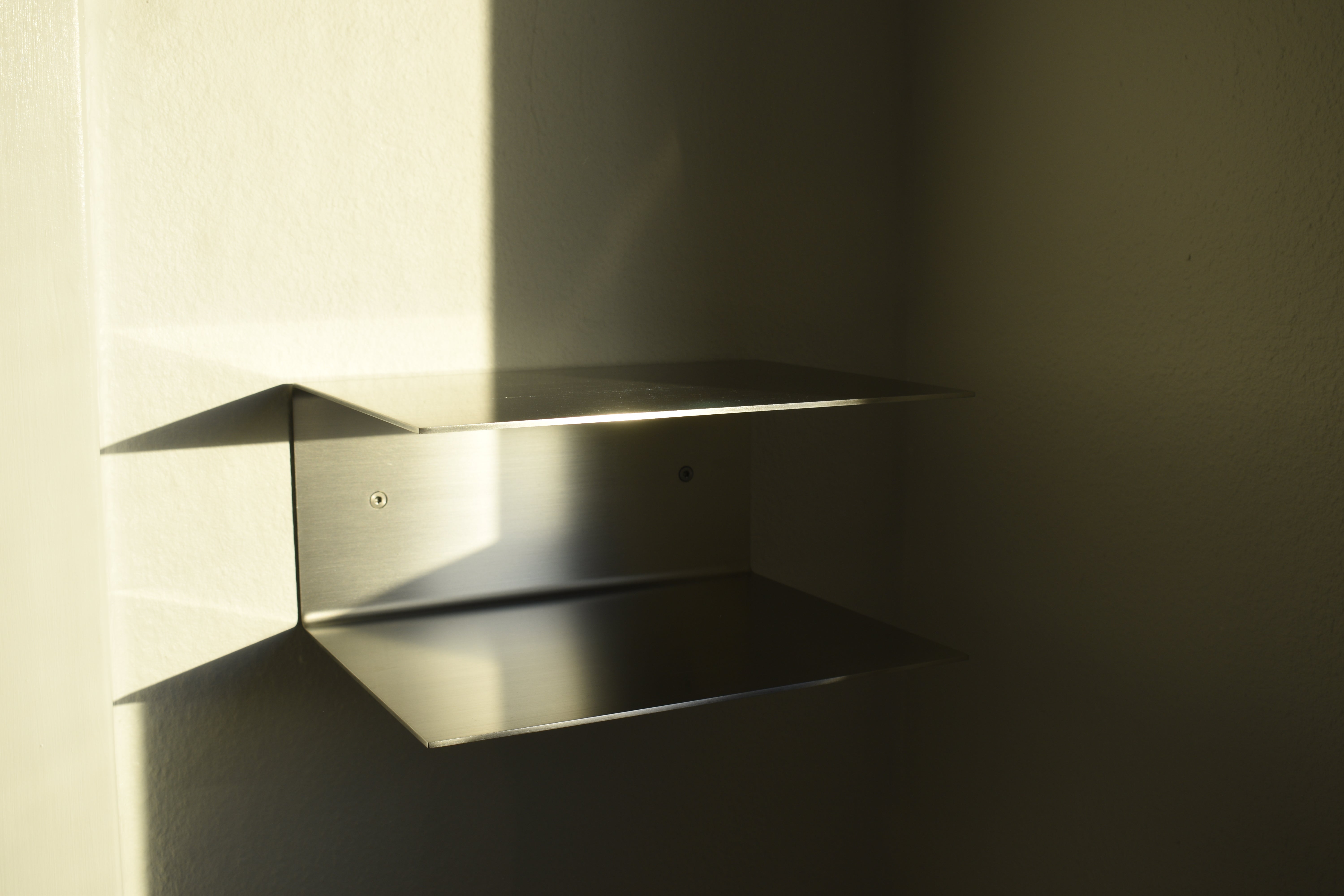
In hand, Lund reads as a compact, rigid unit without resonance. The surface has a uniform, linear brush finish that is easy to maintain, and the bearing surfaces are dimensioned to withstand pressure from books, phones, and glasses. The screws work in shear, not just in tension, because the shelf locks into the two planes of the corner. This provides mechanical security that normally requires larger brackets. See more about proportions and mounting on the Lund bedside table product page.
Maintenance and Mounting Longevity Over Time
Indoors, stainless steel requires modest care, but small habits extend its lifespan and preserve the passive film.
- Cleaning: Wipe with a soft microfiber cloth and lukewarm water with pH-neutral soap. Remove fingerprints with isopropyl alcohol on a clean cloth. Wipe in the direction of the grain to avoid cross-marks.
- Avoid: Chlorine-containing cleaners, scouring cream, and steel wool. They can damage the passive film or deposit free iron, which can later discolor the surface.
- Slight discoloration: “Tea staining” can be removed with citric acid-based products designed for stainless steel. Rinse thoroughly and dry afterwards.
- Fasteners: Use A2 screws in dry rooms, A4 where humidity is high, e.g., in bathrooms. After the first few weeks, screws can be gently retightened, especially in drywall, and then annually. Check that brackets are completely flush with the wall to avoid point pressure.
- Drilled edges: If re-drilling, edges should be slightly chamfered and wiped free of shavings to prevent local stress concentrations or contamination at the hole. Ideally, drilling and finishing are done in the workshop, not on site.
Along the wall, a correctly passivated shelf bracket remains chemically stable. Mounting points do not degrade with normal indoor use because stresses are distributed and the surface does not corrode around the screws when materials and finishing are chosen correctly.
In conclusion, the strength of an indoor stainless steel wall shelf is not just about modulus and strength figures, but an interplay between material, geometry, and anchoring. When the steel is passivated and the beam action is built into the bracket, the shelf maintains its shape without sagging. For a home that changes over time, this constructive stability and a neutral, durable surface provide long-term value: the wall is less stressed, the surface patinates discreetly, and functionality remains intact year after year.

